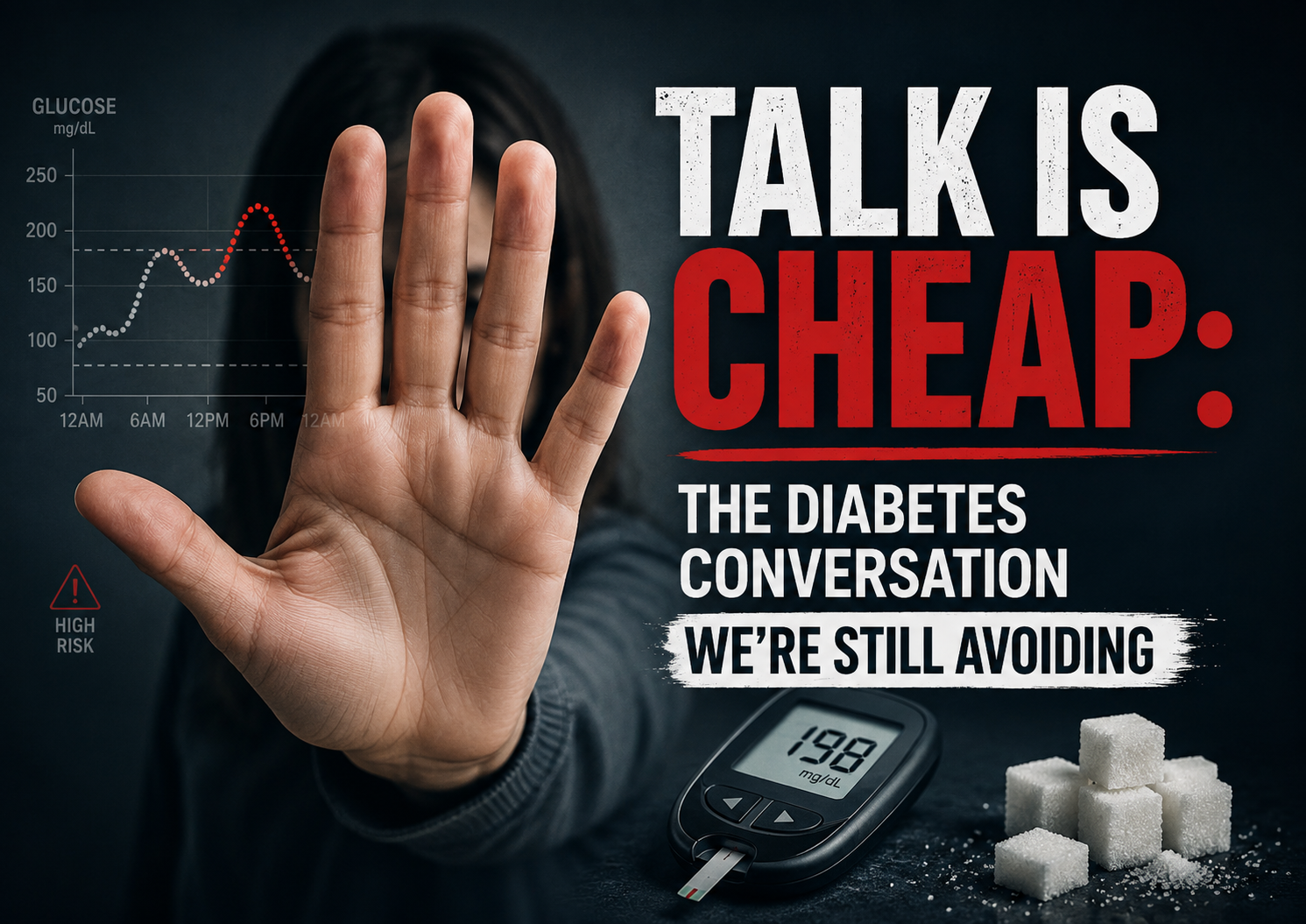
National Diabetes Week has arrived, and this year Australians living with diabetes are being encouraged to “Live Out Loud” by sharing what they wish other people understood about the condition.
Listening matters. Reducing stigma matters. The experiences of people managing type 1, type 2, gestational and less common forms of diabetes deserve to be heard. But in the middle of a rapidly growing national health crisis, listening really can’t become a substitute for action.
We’ve been talking about diabetes for decades yet the epidemic has continued to grow anyway.
The latest Australian Bureau of Statistics data show that one in 15 Australian adults now has diabetes, up from one in 20 a decade earlier. Another 2.7 per cent are considered at high risk. Diabetes contributed to around 20,800 deaths in 2024, (that’s almost 60 people a day !) was associated with 1.3 million hospitalisations in 2023–24 and accounted for approximately $4.4 billion in direct health expenditure.
At what point does “raising awareness” become an inadequate response to a crisis we are plainly failing to contain?
This is not an argument against supporting people who live with diabetes. Nor is it an attempt to lump all forms together. Type 1 diabetes is an autoimmune condition and is not currently preventable. Type 2 diabetes is complex, influenced by genetics, age, cultural background, socioeconomic circumstances and other factors. It should never be reduced to laziness or personal failure.
But complexity shouldn’t become an excuse for lack of real time proactive solutions.
For many people, the progression towards insulin resistance and type 2 diabetes begins years before diagnosis. Yet our health system remains heavily weighted towards identifying disease AFTER it has developed, prescribing treatment and managing complications. It seems the government is prepared to fund the consequences, while repeatedly hesitating over policies that might reduce new cases.
Australia does not merely have an information problem. Most people know that vegetables are healthier than confectionery and regular movement is beneficial. What we have is an environment problem.
People make decisions inside systems that are shaped by price, availability, working hours, transport, housing, education, advertising and commercial influence. Healthy behaviour is harder when fresh food is expensive, time is scarce, neighbourhood design discourages walking, and heavily marketed ultra-processed products are cheap and convenient.
Telling people to “make better choices” while leaving those conditions untouched isn’t prevention. It’s blame dressed up as health advice.
The government’s own health strategies acknowledge that social, economic and physical environments shape individual decisions. Yet acknowledgement is not implementation. A parliamentary inquiry made practical recommendations, including clearer front-of-pack information about added sugar, a levy on sugar-sweetened drinks, restrictions on unhealthy food advertising to children, improved access to healthy food and stronger action to change environments that make unhealthy choices easier.
In its 2026 response, the Australian Government merely “noted” the recommendations on added-sugar labelling, a sugary-drink levy and regulation of unhealthy food marketing to children. It offered support in principle for tackling obesogenic environments and for national public-health campaigns, but support in principle is not the same as funded, measurable action.
This is where Australians have every right to become impatient.
Why are children still immersed in sophisticated marketing for nutritionally poor products? Why is healthy food often the more expensive and less convenient choice? Why are evidence-based behaviour-change programs not routinely available through primary care before blood glucose reaches the diagnostic threshold? Why do we wait until people are sick enough to qualify for intensive support?
The government’s own feasibility study found no evidence that industry self-regulation has effectively protected Australian children from unhealthy food marketing. It reported that children continue to be exposed across media and other settings, with little meaningful change since voluntary industry codes were introduced.
A serious national response needs to begin much earlier.
- It would provide accessible risk screening and metabolic health checks, followed by practical support rather than a pamphlet and a warning to “lose some weight.” It would fund longer consultations and sustained programs involving dietitians, diabetes educators, exercise professionals, community health workers and appropriately trained practitioners.
- It would invest in behavioural science: goal setting, coaching, peer support, culturally relevant education, feedback and follow-up designed around the realities of people’s lives. One enthusiastic consultation rarely reverses habits and metabolic changes developed over years.
- It would also make healthier choices easier: affordable nourishing food, healthier school and hospital environments, restrictions on marketing to children, communities designed for safe movement, and targeted programs developed **with—not simply imposed upon—**Aboriginal and Torres Strait Islander communities, rural populations and disadvantaged areas.
Nearly one in six Aboriginal and Torres Strait Islander adults has diabetes, rising to more than one in five in remote areas. These figures should end any lingering fantasy that this epidemic can be solved by lecturing individuals about willpower.
National Diabetes Week should amplify the voices of people living with diabetes. But perhaps we should listen to what those numbers are shouting as well.
Awareness without prevention is not enough. Sympathy without structural change is not enough. Strategies without implementation are not enough.
So yes, let’s talk about what it’s like to live with diabetes.
But let us also talk—loudly—about WHY so many Australians are developing type 2 diabetes, who benefits from the environments driving it, and why governments remain more comfortable managing the epidemic than confronting it.
The conversation Australia urgently needs is not simply:
“What’s it like to live with diabetes?”
Perhaps it should be:
“What are we prepared to change so fewer people have to live with it?”